Not every disability home looks the same. And under the NDIS, that’s exactly the point.
If you’ve started researching Specialist Disability Accommodation, you’ve probably noticed that no two SDA homes are described the same way. One listing mentions ceiling hoists and backup power. Another talks about wide hallways and step-free showers. A third focuses on reinforced walls and secure outdoor space.
These aren’t random differences. They’re SDA design categories, a system the NDIS uses to match housing features to the actual support needs of the person living there. Understanding them isn’t just useful background reading. It’s the difference between ending up in a home that genuinely works for you, and one that doesn’t.

In this article, we will break down all four NDIS SDA design categories in plain English, so you know exactly what each one means, who it’s built for, and how to figure out which one applies to you.
What Are SDA Design Categories?
Specialist Disability Accommodation (SDA) is designed for NDIS participants whose disability-related needs make ordinary housing unsuitable.
It is intended for people with extreme functional impairment or very high support needs, with only around 6% of NDIS participants eligible for SDA. Because these homes need to accommodate specific accessibility and support requirements, SDA properties are built or modified to meet specialised design standards rather than following the layout of typical rental housing.
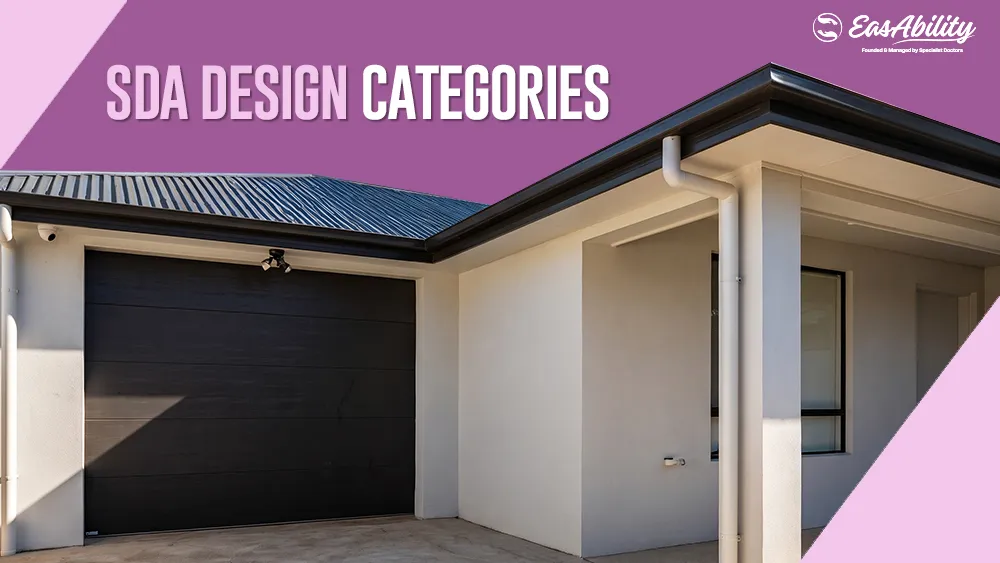
To maintain consistent quality, the NDIS introduced the SDA Design Standard in 2019, which has been mandatory for all new and refurbished builds since 1 July 2021. This standard sorts every SDA dwelling into one of four SDA housing categories:
- Improved Liveability
- Fully Accessible
- High Physical Support
- Robust
Each category has its own set of mandatory design features and is priced differently under the NDIS pricing arrangements. Studio-style accommodation doesn’t qualify under any category. The standard applies to houses, villas, duplexes, townhouses, apartments and group homes.
Why the Right Design Category Matters
Choosing or being assigned the correct category isn’t a formality. Get it wrong, and you end up paying for infrastructure you don’t need, or, worse, living somewhere that can’t safely support your daily needs.
The right category means:
- Your home reduces your reliance on support workers for basic tasks
- Safety risks — falls, isolation, sensory overload — are designed out from the start
- Your NDIS SDA funding is spent on features that genuinely improve your independence, not generic renovations
This is why the NDIA doesn’t let participants simply pick a category. It has to be backed by evidence.
Improved Liveability SDA
Improved Liveability is the entry-level design category, built for people with sensory, intellectual or cognitive impairments rather than significant physical disability.
The goal here isn’t wheelchair access; it’s reducing confusion, sensory stress and the risk of accidents around the home.
Typical features include:
- Single-storey layouts to remove stairs
- Clear visual contrast between walls, floors and doors
- Tactile switches and lever-style door handles
- Simple, intuitive floor plans that are easy to navigate
- Reduced sensory triggers such as harsh lighting or echo-heavy rooms
Improved Liveability SDA is suitable for participants who might live fairly independently but need a home designed to lower daily cognitive and sensory load.
Fully Accessible SDA
Fully Accessible steps up the physical access requirements considerably. This category is built for people with significant physical impairment, typically wheelchair users, who need to move through and use every part of the home without barriers.
Key features include:
- Step-free entry and wide internal doorways and hallways
- Wheelchair-accessible kitchens, with adjustable bench heights
- Accessible bathrooms with roll-in showers and appropriate clearances
- Reinforced walls in bathrooms to support grab rails
- Accessible outdoor areas and parking
Fully Accessible SDA is about physical independence; being able to cook, shower, and move around your own home without needing someone else to compensate for design gaps.
High Physical Support SDA
High Physical Support is the most technically complex and highest-funded of the SDA housing categories. It’s designed for participants with very high physical support needs, complex medical requirements, or progressive conditions that require constant infrastructure support.
This category includes everything in Fully Accessible, plus:
- Ceiling hoists in bedrooms and bathrooms
- Emergency power backup for essential medical equipment
- Assistive technology and communication systems built into the home
- Smart-home features: automated doors, blinds and sensor lighting for hands-free control
- Space and structural provisions for 24/7 onsite support
High Physical Support SDA exists for people whose safety and quality of life depend on infrastructure that a standard accessible home simply doesn’t provide.
Robust SDA
Robust is a different kind of category altogether; it isn’t about physical access at all. It’s built for participants who may show behaviours that could unintentionally or intentionally damage a standard property, or who need a secure, low-stimulus environment.
Robust homes typically feature:
- Impact-resistant walls, doors and fittings
- Reduced fire-risk materials and fittings
- Secure, fenced outdoor space to prevent wandering
- Soundproofing to manage noise and sensory impact
- Layouts that protect both the participant and support staff
Robust SDA prioritises durability and safety over accessibility features — though many Robust homes also include accessible design where needed.
How the NDIS Decides Your SDA Design Category
You don’t get to simply choose a category; the NDIA approves one based on evidence. This usually comes from:
- An Occupational Therapist’s functional capacity assessment
- Reports from treating specialists or support coordinators
- Evidence of how specific design features would reduce your support needs
- Your personal goals for independence and daily living
The assessment looks at how each design feature would actually change your day-to-day life, not just what condition you have on paper. This is why two people with similar diagnoses can sometimes be approved for different categories.
Can One Home Cover More Than One Category?
Yes, and this is increasingly common. Many SDA providers now build homes that combine features across categories, since real-world needs rarely fit neatly into one box. You might need Fully Accessible features alongside Robust durability, or High Physical Support equipment combined with the sensory-friendly layout of Improved Liveability.
Providers that build across multiple categories also reduce vacancy risk, because a single dwelling can suit a wider range of participants — which is good news for anyone searching for SDA homes that don’t force a compromise.
Finding SDA Housing Categories in Adelaide
If you’re searching for SDA housing Adelaide or NDIS housing Adelaide, local options can be harder to compare.
EasAbility is a doctor-led, NDIS-registered SDA provider based in Adelaide, currently managing SDA vacancies across High Physical Support and Robust design categories, including properties in Modbury North and Elizabeth Vale. Every home is matched to a participant’s approved support category from day one, with dedicated care built in rather than added on later.
If you’re trying to work out which SDA Adelaide option fits your NDIS plan, speaking with a local provider who understands both the clinical side and the design standards can make the process considerably less overwhelming.
Final Thoughts
Choosing the right SDA design category is an important part of finding a home that meets a participant’s needs. Each category has its own minimum design requirements, so understanding which one applies to you is the first step towards finding a home that supports your independence rather than limiting it. The dwelling should also continue to meet the requirements of the approved category throughout the tenancy.
Frequently Asked Questions
What are the 4 SDA design categories?
The four SDA design categories under the NDIS are Improved Liveability, Fully Accessible, High Physical Support, and Robust. Each one sets minimum design requirements tailored to a different level of physical, sensory, or behavioural support needs.
What is the difference between Fully Accessible and High Physical Support SDA? Fully Accessible focuses on physical access — step-free entry, wheelchair-friendly kitchens and bathrooms. High Physical Support includes all of that plus advanced infrastructure like ceiling hoists, emergency power backup and assistive technology for participants with complex medical needs.
Who decides which SDA design category I qualify for? The NDIA approves your design category based on evidence from an Occupational Therapist’s functional assessment, treating specialists, and your support coordinator. You can’t simply choose a category without supporting documentation.
Can I live in a Robust SDA home if I don’t have behavioural support needs? Robust homes are specifically designed for participants whose behaviours could damage a standard property or who need a secure, low-stimulus environment. If that doesn’t describe your needs, another category is likely more appropriate.
How much funding does each SDA design category receive? Funding varies significantly by category, building type and location, with High Physical Support attracting the highest price limits due to its infrastructure requirements. Exact figures are set annually in the NDIS Pricing Arrangements for Specialist Disability Accommodation.
Can one SDA home have more than one design category? Yes. Many providers now build homes that combine features from multiple categories, such as Fully Accessible access with Robust durability, to suit a wider range of participant needs and reduce vacancy risk.
Is Improved Liveability SDA only for people with physical disabilities? No. Improved Liveability is specifically designed for people with sensory, intellectual or cognitive impairments, focusing on layout clarity, visual contrast and reduced sensory stress rather than wheelchair access.
Do I need an Occupational Therapist report to apply for SDA? Generally, yes. An OT functional assessment is one of the main pieces of evidence the NDIA uses to determine both your SDA eligibility and which design category best matches your needs.
How do I find SDA housing in Adelaide that matches my design category? Start by confirming your approved design category on your NDIS plan, then contact a registered SDA provider operating in your area, such as EasAbility Care in Adelaide, to check current vacancies matching that category.
What happens if my needs change after I move into an SDA home? If your support needs change, your NDIS plan and SDA category can be reassessed. This may involve a new OT assessment and, depending on the outcome, a transition to a home in a different design category.
EasAbility Care – General Information Disclaimer
The information provided on this page is for general informational purposes only and does not constitute professional, legal, medical, or NDIS advice. While reasonable efforts are made to ensure the accuracy of the content, EasAbility Care makes no representations or warranties regarding the completeness, reliability, or suitability of the information provided.
Please note:
- EasAbility Care provides a range of disability support services designed to assist NDIS participants in achieving their goals, increasing independence, well-being, and community participation.
- EasAbility Care offers various NDIS-related supports, and the availability of specific services may vary depending on individual circumstances, funding, and location.
- Eligibility for NDIS funding and related support is determined solely by the National Disability Insurance Agency (NDIA) based on a participant’s individual needs, goals, and assessments.
- Access to services, funding approvals, and support arrangements may vary depending on a participant’s NDIS plan and personal circumstances.
- Users should seek independent advice from the NDIA, Support Coordinators, Support Workers, Psychiatrists, Psychologists, General Practitioners, or other qualified professionals before making decisions based on the information available on this website.
To the maximum extent permitted by law, EasAbility Care accepts no liability for any loss or damage arising from reliance on the information contained on this website. This disclaimer may be updated at any time without notice.