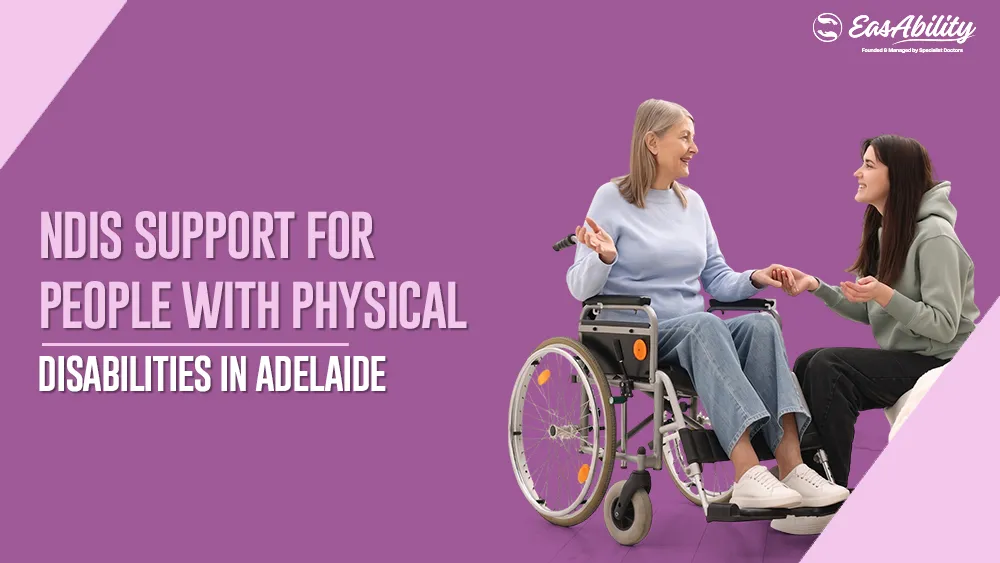
If you or someone you care for has a physical disability, the NDIS can help pay for the support you need at home and in the community. This guide explains what is available, who can apply, and how to find disability support services in Adelaide.
What Is NDIS Support for People with Physical Disabilities?
NDIS support for physical disabilities provides funding to help a person with a physical disability do everyday tasks, stay safe, and take part in community life. The funding sits in an individual NDIS plan and pays for supports that are “reasonable and necessary” for that person’s goals.
Physical disability support covers many conditions, such as cerebral palsy, spinal cord injury, muscular dystrophy, multiple sclerosis, and acquired brain injury.

To qualify for the NDIS under the disability requirements, a person must have a permanent impairment that substantially reduces their ability to manage everyday activities. The impairment must also affect their ability to work, study or participate in social life, and they must be likely to need NDIS supports throughout their lifetime.
Two people with the same condition can have very different plans.
What NDIS Services Are Available for Physical Disabilities?
NDIS services for people with physical disabilities include personal care, mobility support, help at home, community access, transport, nursing and housing. Which ones you can use depends on what is written in your plan.
Common supports include:
- Personal care: help with showering, dressing, toileting and meals.
- Mobility support: help to move safely at home and in the community, plus assistive technology such as wheelchairs or hoists where funded. Assistive technology can include manual or powered wheelchairs, walking aids, shower chairs, transfer equipment and hoists. The type of equipment funded depends on the participant’s functional needs and NDIS plan.
- Daily living support: help with household tasks, routines, and skill-building.
- Community access: support to attend activities, work, study or social events.
- Nursing support: clinical care, such as wound care, when a registered nurse is required to provide disability-related clinical support.
- Accommodation support: help to live in a shared or supported home.
Who is Eligible for NDIS Support?
To be eligible for the NDIS, a person generally needs to be under 65 when they apply, live in Australia as a citizen, permanent resident or Protected Special Category Visa holder, and have a permanent and significant disability. Some people may qualify through the early intervention requirements instead.
To apply, submit an access request with evidence of your disability, often from a doctor or allied health professional. The National Disability Insurance Agency (NDIA) decides whether to approve it, and no provider can promise an outcome. The NDIS website has the current eligibility details.
Once you are approved, the NDIA builds a plan around your goals and support needs; the amount of funding is not published as a standard figure. It varies from person to person.
How Does NDIS Support Help with Daily Living?
NDIS daily living support helps people with physical disabilities complete routine tasks so they can stay as independent as possible. A support worker assists with the parts of a task that are difficult, while the participant keeps choice and control.
Some practical examples:
- A person with limited hand strength gets help preparing meals and learns adapted techniques over time.
- A person who uses a wheelchair gets help with laundry and cleaning, which frees energy for work or study.
- A person recovering from a spinal injury works with a support worker on a morning routine, building towards doing more on their own.
NDIS Home Care, Personal Care and Mobility Support
Home, personal care and mobility support are the supports most people with physical disabilities use every day. They can be delivered as in-home disability support in Adelaide or as help when you are out and about.
NDIS home support and disability support at home cover tasks such as cooking, cleaning, shopping and keeping the home safe. Home modifications, such as ramps, accessible bathrooms or grab rails, are assessed separately from assistive technology. A qualified occupational therapist must complete the required home modification assessment, which helps the NDIS determine whether the proposed changes meet its funding requirements.
NDIS personal care is hands-on help with showering, dressing, grooming, toileting and eating. Support workers are trained to do this with dignity and respect for your routines.
NDIS mobility support includes help with transfers, walking aids, and safe use of equipment. Travel is also part of mobility. If your plan includes transport funding, it may help you travel to work, study, day programs and community activities when you cannot use public transport independently because of your disability. The funding available depends on your circumstances and NDIS eligibility criteria.
NDIS community participation supports help you leave the house, meet people, and try new activities, from a coffee catch-up to a weekly group.
Nursing support applies when care needs a registered nurse. NDIS-funded nursing support is intended for disability-related health needs that meet NDIS funding requirements. It may include assistance with complex wound care, catheter management or other ongoing clinical support. General healthcare services, such as hospital treatment and routine GP appointments, remain the responsibility of the mainstream health system.
Occupational Therapy is when an occupational therapist assesses how a person’s physical disability affects everyday activities and recommends suitable equipment or home modifications. Their assessment may help identify changes that make moving around, personal care and household tasks safer and easier
Housing options for adults with physical disabilities
For adults with physical disabilities, suitable housing may need features such as step-free access, wider doorways, accessible bathrooms, wheelchair-friendly kitchens and space for mobility equipment. The right housing arrangement depends on the person’s functional needs, accessibility requirements and available NDIS funding.
- Supported Independent Living (SIL) funds support workers who help participants manage everyday activities at home. This may include personal care, meal preparation, household routines and supervision. SIL can involve shared or individual support worker arrangements, depending on a participant’s support needs. It provides assistance or supervision with everyday activities at home and does not cover rent, groceries or general household expenses.
- Specialist Disability Accommodation (SDA) funds specially designed housing for people with extreme functional impairment or very high support needs. Only some participants can qualify for SDA.
Neither SIL nor SDA is available to everyone. They need to be approved in your plan.
How to Find Disability Support Services in Adelaide
To find disability support services in Adelaide, start with your plan, then compare NDIS providers in Adelaide with your needs.
Check whether the provider is registered and whether registration is required for your funding arrangement and the services you need. Participants with NDIA-managed funding generally need to use registered providers. SIL providers are also subject to mandatory registration requirements, which commenced on 1 July 2026. The NDIS Commission has outlined transitional arrangements for eligible providers that applied for registration before 1 October 2026. SDA providers must also meet specific registration requirements.
Useful questions to ask any provider:
- Do you offer the supports in my plan, such as personal care, community access and in-home support?
- Who will my disability support workers be, and can I meet them first?
- How do you handle changes to my roster or needs?
- Can you work with my support coordinator, plan manager and family?
- Who oversees clinical quality?
If your NDIS plan funds a support coordinator, they can help you understand your supports, connect with suitable providers, and coordinate different services. They can also help you navigate changes to your support arrangements. However, you still choose your provider.
How EasAbility Supports People with Physical Disabilities
Finding the right disability support often comes down to having a team that understands your needs, respects your choices and provides consistent care.
As a doctor-led, registered NDIS provider in Adelaide, EasAbility provides a range of supports for adults with physical disabilities, including:
- Personal care and in-home disability support
- Community participation and community access
- Nursing support
- Supported Independent Living (SIL)
- Transport and mobility support
For participants exploring Specialist Disability Accommodation (SDA), EasAbility can also help them understand suitable housing options and connect with registered SDA providers where appropriate.
If you’re exploring NDIS support options in Adelaide, EasAbility can help you understand the services available and discuss what might work with your individual needs and NDIS plan.
Frequently Asked Questions
- What does NDIS cover for physical disabilities?
The NDIS can fund reasonable and necessary supports for your disability, such as personal care, mobility assistance, daily living support, community access, nursing, and assistive technology. What you receive depends on your plan. - Can the NDIS pay for a support worker to come to my home?
Yes, if in-home support is in your plan. Support workers can help with personal care, household tasks and routines at home. - Is a wheelchair covered by the NDIS?
The NDIS can fund wheelchairs and other assistive technology when they meet the funding requirements and are included in your plan. Depending on the equipment, you may need advice or an assessment from a suitably qualified professional, such as an occupational therapist, physiotherapist or rehabilitation engineer. - Do I need to be on the NDIS to get disability support in Adelaide?
No, but NDIS funding pays for most registered services. Other supports may be available through My Aged Care for people over 65, or through other government programs. - What is the difference between SIL and SDA?
SIL pays for the support you receive in your home. SDA pays towards the cost of specially designed housing. A person can have one, both or neither. - How long does it take to get NDIS support?
Timeframes are set by the NDIA and change over time, so we cannot give a reliable figure. The NDIS website has current information.
EasAbility Care – General Information Disclaimer
The information provided on this page is for general informational purposes only and does not constitute professional, legal, or NDIS advice. While reasonable efforts are made to ensure accuracy, EasAbility Care makes no representations or warranties regarding the completeness, reliability, or suitability of the information.
Please note:
- EasAbility Care supports NDIS participants by assisting them to explore suitable accommodation options and other disability supports.
- EasAbility Care provides SIL services, community participation, and other NDIS-related supports.
- EasAbility Care may not own, manage, or directly provide Specialist Disability Accommodation (SDA) housing and usually works with registered SDA providers to help identify appropriate options.
- Eligibility for SDA and related supports is determined solely by the National Disability Insurance Agency (NDIA).
- Users should seek independent advice from the NDIA, Support Coordinators, or other qualified professionals before making decisions based on this information.
To the maximum extent permitted by law, EasAbility Care accepts no liability for any loss or damage arising from reliance on the information contained on this website. This disclaimer may be updated at any time without notice.