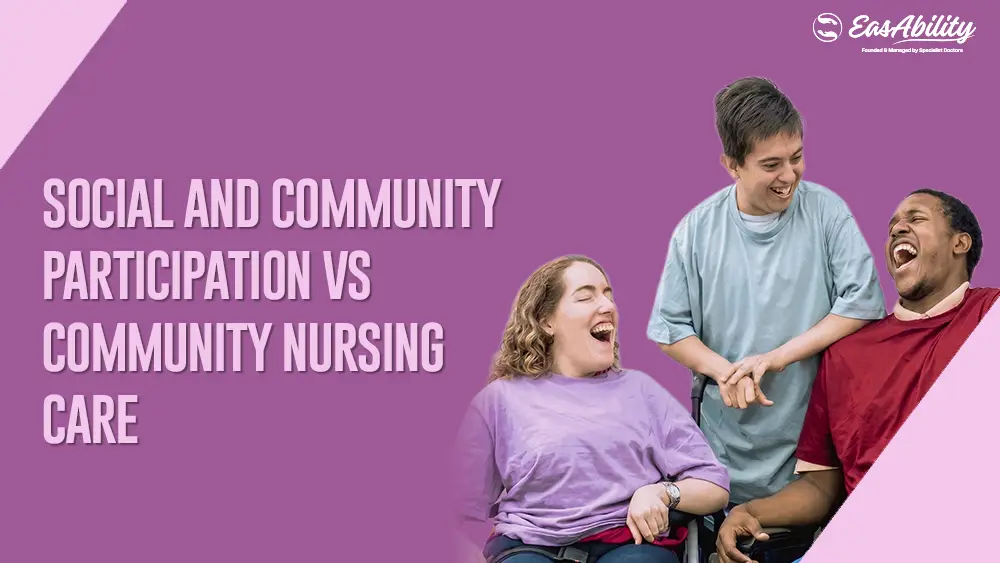
Social and community participation helps you take part in everyday life. Think outings, clubs, classes and meeting people. Community nursing care is health care a nurse delivers at home instead of in hospital. It covers clinical tasks (medical care that needs a trained health professional), such as wound care or catheter care.
If you have an NDIS plan, you may see both social and community participation and community nursing care listed. Both can happen at home or out in the community, but they do very different jobs.
This guide explains each service, shows how they differ and outlines what the NDIS may fund. It also helps you to find NDIS support services in Adelaide.

What Is Social and Community Participation?
Social and community participation supports you in taking part in social, recreational, and community life. A trained support worker usually provides it, not a nurse.
The goal is to help you do things you enjoy, meet people, build skills and feel connected. Support can be one-to-one or in a group.
Examples of NDIS community participation support include:
- Going to a café, library or movie with a support worker
- Joining a sports club, art class or social group
- Visiting places like the Adelaide Botanic Garden or Glenelg Beach
- Learning to use public transport safely
- Going to community events or volunteering
In an NDIS plan, this support may sit under Core Supports in a category called Assistance with Social, Economic and Community Participation. It may also appear under Capacity Building as Increased Social and Community Participation, which focuses on building your skills. The category name can change, so make sure to check your current plan.
EasAbility offers community participation support for people across Adelaide who want to get out, get involved and build independence
What Is Community Nursing Care?
Community nursing care is nursing care delivered in your home or community. A registered nurse or an enrolled nurse provides it. (A registered nurse holds a university-level qualification. An enrolled nurse works under a registered nurse’s guidance.)
The NDIS describes it as disability-related nursing care for participants with high care needs. It is clinical care, meaning it involves medical tasks that require a nurse’s skills.
Community nursing care may include:
- Catheter care: looking after a tube that drains urine from the bladder
- Tracheostomy care: caring for an opening in the neck that helps with breathing
- Wound and pressure care: treating wounds and protecting fragile skin
- Medication management: checking and giving medicines safely
- Skin integrity checks: checking skin for early signs of pressure injuries
- Training support workers: teaching them how to respond to complex health needs
Nurses also work with your GP, specialists and other supports. Find out more about EasAbility’s nursing support.
Key Differences Between Both Services
Social and Community Participation | Community Nursing Care | |
Main purpose | Take part in social, recreational and community life | Provide eligible disability-related clinical care |
Who provides it | A support worker with appropriate skills | Registered or enrolled nurse |
Type of support | Everyday, social and skill-building | Clinical and medical |
Where it happens | Community venues, group programs, outings | Usually your home or community setting |
Examples | Cafe outing, sports club, learning public transport | Catheter care, wound care, medication management |
Typical goal | Connection, confidence, independence | Health, safety, comfort |
Funding consideration | Assistance to participate may be funded; ordinary activity costs generally are not | Disability-related nursing support may be funded when eligibility and funding requirements are met |
Community activities versus clinical nursing tasks
Community activities are everyday and social. A support worker might go with you to a social club, a gym class or the shops. Clinical nursing tasks are medical. A nurse might change a wound dressing or check a catheter.
For example, Sam has a catheter and loves football. A nurse looks after his catheter care. A support worker takes him to the local match. It is one person with two different needs, so two different services.
Many people use both, and the two can work well together.
What Does the NDIS Fund Under Each Service?
Funding is not automatic for either service. The support must meet the relevant NDIS funding rules, relate to your disability support needs and align with your plan.
Social and community participation. The NDIS may fund the support you need to take part in activities, such as a support worker who goes with you. It generally does not pay for the activity itself, such as tickets, memberships or entry fees. It also funds entry-level participation, not professional or elite participation.
Community nursing care. The NDIS may fund disability-related nursing care for people with high care needs. It generally does not fund nursing for health events unrelated to your disability. It also usually does not fund care the health system should provide, such as hospital-in-the-home or short-term nursing after surgery.
Your NDIS planner, Local Area Coordinator or support coordinator can help you check what applies to you. For nursing, advice or a letter from your GP or specialist may help show why you need the support. Before you book, you can also check the NDIS guidelines at ndis.gov.au.
How to Find NDIS Support Services in Adelaide
Finding the right provider is easier with a plan. Try these steps:
- Check your plan. Review your goals and which budgets cover community participation or nursing.
- Decide what you need. Is it activities, nursing, or both?
- Search for registered providers. Use the NDIS Provider Finder on the NDIS website. The NDIS Quality and Safeguards Commission also lists registered providers.
- Ask questions. For nursing, ask whether nurses are registered with AHPRA (the Australian Health Practitioner Regulation Agency) and have experience with your needs. For community participation, ask whether activities can match your interests and which Adelaide suburbs the provider covers.
- Ask for help. A support coordinator can compare providers and set up services for you.
Frequently Asked Questions
- Can a support worker help with health tasks, such as catheter care?
A trained support worker may assist with routine catheter care if they have completed the required high-intensity support training and follow an appropriate clinical care plan.
- Can I join community activities if I have complex health needs?
Yes. Complex health needs do not necessarily prevent you from participating in community activities. The NDIS may fund appropriate support to help you take part safely, depending on your individual needs, plan and funding eligibility.
- Does the NDIS help with getting to community activities?
It can. The NDIS may fund transport help for people who cannot travel or use public transport on their own, including transport to take part in community activities. It must be in your plan and meet NDIS rules. Ask your planner or support coordinator how transport works in your plan.
- Do I have to use a registered NDIS provider?
It depends on how your plan is managed. If the NDIA manages your funding, you must use a registered provider. Plan-managed and self-managed participants can also use unregistered providers. Some supports have extra rules, so check with your plan manager first.
- What happens if I need to cancel a visit?
Your service agreement should explain the cancellation policy. Depending on the support type and applicable NDIS claiming rules, a provider may be able to claim a short-notice cancellation fee. Different notice periods apply to different supports, and specific conditions must be met. Ask your provider about its policy before booking.
- Can I change providers part way through my plan?
Yes. Choice and control are core NDIS principles, and participants generally don’t have to pay exit fees when they change providers. Check your service agreement for how to end it and how much notice to give
Talk to EasAbility About Support in Adelaide
EasAbility is a doctor-led, NDIS-registered provider based in Adelaide. Our clinical background means we understand both the health and everyday sides of disability support. Whether you need a support worker to help you get out in the community, a nurse to manage a health need, or both, our team can help you work out the next step.
When you contact us, we can help you:
- Understand which service suits your needs and goals
- See how community participation and nursing support can work together
- Learn about the supports we offer across Adelaide
- Plan your next steps with your family or support coordinator
It helps to have your NDIS plan and a short list of your daily activities and health needs on hand. You do not need to have everything worked out first.
Contact EasAbility to ask about community participation, community nursing care or both.