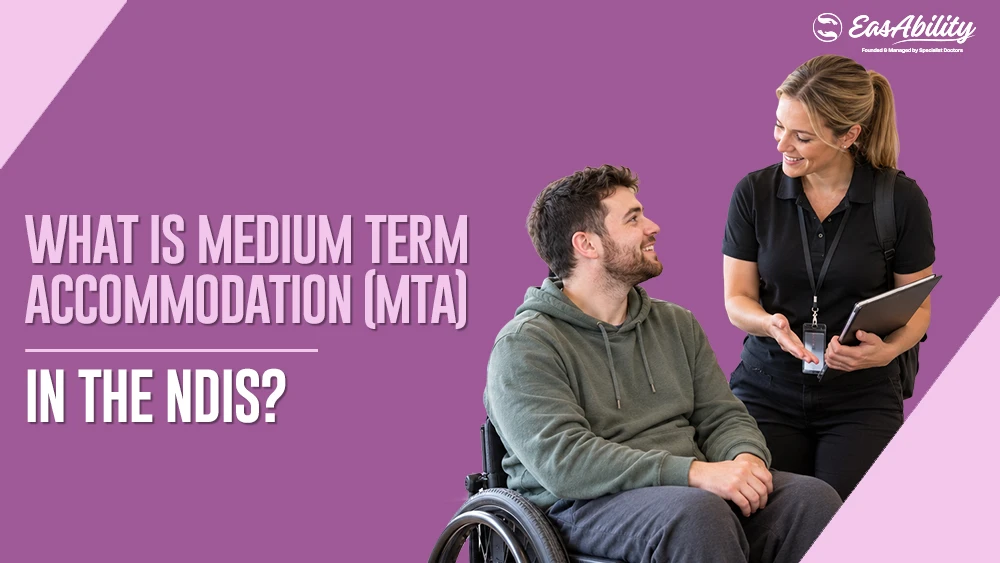
If you need somewhere to live temporarily while your longer-term housing arrangements are being sorted out, Medium Term Accommodation (MTA) can be an option.
MTA is temporary accommodation funded by the NDIS in specific circumstances. It provides a participant with a suitable place to stay while they wait for their longer-term housing arrangements to be ready.
But MTA isn’t simply a spare room or a place to stay for a few weeks. The accommodation needs to address the person’s disability-related needs and circumstances. So, what does MTA accommodation actually involve, and what should you look for when arranging it?

What Does MTA Accommodation Look Like?
There isn’t one standard type of Medium Term Accommodation. Depending on the provider and the participant’s needs, MTA may be provided in a house, unit, apartment or another suitable property. The important consideration is whether the accommodation is practical and appropriate for the person staying there.
For example, someone with mobility needs may need:
- Step-free access
- An accessible bathroom
- Enough space to move around safely
- Suitable bedroom arrangements
- Room for a wheelchair or other mobility equipment
Someone else may need accommodation close to family, medical appointments, support workers or familiar community facilities.
This means two people looking for MTA may have very different requirements. So, the access depends on people’s circumstances and their MTA requirements.
For the specific rules around who is eligible for MTA, see our guide: Who Is Eligible for MTA Funding and How Long Can You Stay?
What Should You Look for When Choosing MTA?
Finding MTA accommodation is about more than just finding a place with an available bedroom. The property should be chosen with the participant’s accessibility needs, routines and existing supports in mind.
Accessibility
The property should be easy and safe for the participant to use. Check the entrance, doorways, bathroom, bedroom and other areas they will use regularly.
If the participant uses a wheelchair, mobility aid or other equipment, make sure there is enough space to move around comfortably and that the layout works in practice.
Location
A temporary move can be disruptive, so location matters. Think about how easy it will be for the participant to stay connected with family, friends, support workers and their usual community.
It can also help to consider the distance to medical appointments, shops, public transport and other places the participant visits regularly.
Facilities
Look at what the property actually offers rather than assuming every MTA property has the same facilities. Check whether it has suitable kitchen, bathroom and laundry facilities, and whether the furniture and layout are appropriate for the participant.
If the accommodation is furnished, the setup should still allow the person to live comfortably.
Equipment and Assistive Technology
If the participant uses mobility equipment, assistive technology or other essential items, check that the property can accommodate them before moving in.
This could include enough space for a wheelchair, suitable charging arrangements or room for other equipment used as part of the participant’s daily routine.
Existing Routines and Supports
A temporary move does not have to mean completely disrupting the participant’s usual routine. Consider whether the location and setup will allow existing support arrangements, appointments, community activities and important daily routines to continue as smoothly as possible.
These details can make a big difference to how comfortable someone feels during what may already be a disruptive period.
What About the Participant's Usual Supports?
Moving into MTA does not mean a participant suddenly no longer needs the supports they normally rely on. A person may still need personal care, support work, nursing or other approved supports while staying in temporary accommodation.
The accommodation and those supports are separate considerations. MTA funding is for the accommodation component; other approved supports are dealt with separately according to the participant’s circumstances and plan.
It is therefore worth discussing support arrangements before they move rather than assuming everything will automatically continue in exactly the same way.
What Should You Ask an MTA Provider?
Before agreeing to an MTA accommodation option, it can help to ask some practical questions:
- Is the property suitable for the participant’s accessibility needs?
- Is it furnished?
- What facilities are available?
- Is there enough space for mobility equipment or assistive technology?
- Where is the property located?
- Can existing support workers continue providing support there?
- What needs to be organised before moving in?
- What happens when the participant is ready to move out?
The answers can help you work out whether the accommodation is genuinely suitable rather than simply available.
Finding Medium Term Accommodation in Adelaide
If you’re searching for Medium Term Accommodation Adelaide, location and accessibility are likely to be important considerations. An accommodation option in Adelaide can make it easier to stay connected with family, existing supports, health services and familiar places.
It is also worth looking at the property itself rather than choosing based on location alone. A convenient address isn’t much help if the bathroom, entrance or layout doesn’t work for the participant.
Why Choose EasAbility for MTA in Adelaide?
At EasAbility, we understand that temporary accommodation needs to remain practical for the person using it. Our Medium Term Accommodation in Adelaide is designed for NDIS participants who need a suitable place to stay during a period of transition.
Our team can discuss the participant’s accommodation requirements and available options to help identify a suitable temporary arrangement.
FAQs
What is Medium Term Accommodation?
Medium Term Accommodation is temporary accommodation funded by the NDIS in specific circumstances. It provides a place for a participant to stay while their longer-term housing arrangements are being prepared.
What is included in MTA accommodation?
MTA covers the accommodation component. Everyday expenses such as food, groceries, electricity, and internet are generally not included.
Can I use my usual support workers while staying in MTA?
A participant’s other approved disability supports are separate from their MTA accommodation. Whether existing support workers can continue during the stay will depend on the participant’s individual arrangements.
What should I check before choosing MTA accommodation?
Consider accessibility, location, facilities, space for equipment, existing support arrangements and how practical the property will be for the participant’s everyday routine.
Is MTA emergency accommodation?
No. MTA is a specific NDIS home and living support rather than general emergency housing.
Is MTA accommodation furnished?
This depends on the property and provider. Before moving in, ask what furniture and household facilities are provided and whether anything additional needs to be arranged.
Where can I find MTA accommodation in Adelaide?
MTA accommodation may be available through providers offering temporary accommodation for NDIS participants. EasAbility provides MTA accommodation options in Adelaide.
EasAbility Care – General Information Disclaimer
The information provided on this page is for general informational purposes only and does not constitute professional, legal, medical, or NDIS advice. While reasonable efforts are made to ensure the accuracy of the content, EasAbility Care makes no representations or warranties regarding the completeness, reliability, or suitability of the information provided.
Please note:
- EasAbility Care provides a range of disability support services designed to assist NDIS participants in achieving their goals, increasing independence, well-being, and community participation.
- EasAbility Care offers various NDIS-related supports, and the availability of specific services may vary depending on individual circumstances, funding, and location.
- Eligibility for NDIS funding and related support is determined solely by the National Disability Insurance Agency (NDIA) based on a participant’s individual needs, goals, and assessments.
- Access to services, funding approvals, and support arrangements may vary depending on a participant’s NDIS plan and personal circumstances.
- Users should seek independent advice from the NDIA, Support Coordinators, Support Workers, Psychiatrists, Psychologists, General Practitioners, or other qualified professionals before making decisions based on the information available on this website.
To the maximum extent permitted by law, EasAbility Care accepts no liability for any loss or damage arising from reliance on the information contained on this website. This disclaimer may be updated at any time without notice.