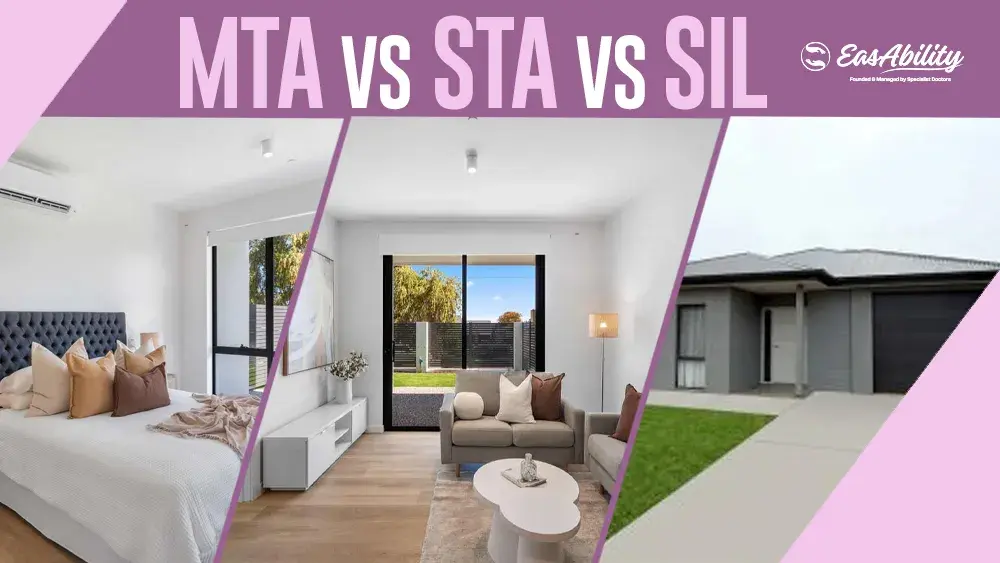
Choosing between NDIS accommodation and home and living supports can be confusing, particularly when terms such as MTA, STA and SIL appear together.
Although all three can be part of a person’s NDIS support journey, they serve different purposes:
- MTA (Medium Term Accommodation) provides temporary accommodation while a longer-term home or living arrangement is being prepared.
- STA (Short Term Accommodation) provides a temporary change from a person’s usual care arrangements.
- SIL (Supported Independent Living) provides ongoing assistance with everyday living at home.
The right option depends less on the type of property and more on what you need the arrangement to achieve.

MTA vs STA vs SIL at a Glance
The three options address different circumstances.
MTA | STA | SIL | |
What it is | Temporary accommodation during a transition to a longer-term home or living arrangement | Short-term accommodation that provides a change from usual care arrangements | Ongoing support with everyday living at home |
Main purpose | Bridges a temporary gap while longer-term housing or support arrangements are being organised | Provides a temporary stay and may give family or informal carers a break | Helps people who need substantial assistance or supervision with daily activities |
Typical situation | Your longer-term home or living arrangement isn’t ready | You need a temporary change from your usual care arrangement | You need ongoing help at home |
Examples of support | Temporary place to stay while arrangements are finalised | Short-term accommodation and related support | Personal care, meals, household tasks and daily living skills |
Duration | Temporary | Short term | Ongoing |
Can it work with other supports? | Yes | Yes | Yes |
MTA vs STA: What Is the Difference?
The main difference between MTA and STA is the reason for the temporary stay.
MTA: A temporary housing transition
MTA may be relevant when your longer-term home or living arrangement is not ready.
For example, you may be waiting for a suitable home to become available, disability-related modifications to be completed, or the necessary supports to be arranged.
The temporary accommodation fills the gap until your longer-term arrangement is ready
STA: A short-term change from usual care
STA is intended for a different situation. It provides a short-term stay away from a person’s usual care arrangements.
For example, a participant who normally lives with family may use STA for a temporary stay while their usual carer has a break from their caring responsibilities.
So although both can involve temporary accommodation, MTA is connected to a longer-term housing transition, while STA is centred on a short-term change from usual care arrangements.
MTA vs SIL: Accommodation or Ongoing Support?
The MTA vs SIL distinction is easier to understand when you separate accommodation from support.
- MTA provides a temporary place to stay during a transition.
- SIL provides support workers who help a person manage everyday activities in their home.
For example, someone may be preparing to move into a longer-term supported living arrangement but cannot move in yet. MTA may help cover the temporary accommodation period, while SIL may form part of the person’s longer-term support arrangement once they move.
SIL can involve assistance with:
- Personal care
- Preparing meals
- Household tasks
- Daily routines
- Developing independent living skills
- Supervision and safety
SIL funding is for the support provided by workers. It does not cover ordinary living costs such as rent or groceries.
STA vs SIL: Short-Term Stay or Ongoing Support?
The STA vs SIL comparison comes down to what the support is intended to achieve.
STA is temporary. It provides a change from a person’s usual care arrangements for a short period.
SIL is ongoing. It is intended for people who need substantial support or supervision with daily living in their home.
For example, a person receiving SIL may normally have support with personal care, meals and household routines. If they need a temporary change from their usual arrangement, STA may potentially be relevant if it meets their circumstances and NDIS requirements.
Receiving SIL does not automatically mean a person needs STA, and STA does not replace an ongoing need for SIL.
Can MTA, STA and SIL Work Together?
These supports can sometimes be part of the same person’s support journey.
For example:
MTA followed by SIL
A participant may stay in MTA while a longer-term supported living arrangement is being prepared. Once the new arrangement is ready, SIL may become part of their ongoing support.
STA alongside ongoing support
Someone who receives ongoing support may also have a short-term stay away from their usual living arrangement where STA is appropriate.
The important point is that the supports are not necessarily alternatives. Their suitability depends on the person’s circumstances, needs and NDIS funding.
Which Option May Fit Your Situation?
Instead of starting with the name of the support, start with what is happening in your life.
“My long-term home isn't ready yet.”
MTA may be relevant when you have a longer-term home or living arrangement but cannot move in yet because the necessary disability-related arrangements are still being organised.
“I need a short break from my usual living arrangement.”
STA may be relevant when you need a temporary change from your usual care arrangements rather than a new long-term home.
“I need regular help with everyday activities at home.”
SIL may be relevant if you need ongoing assistance or supervision with daily living.
“I'm moving into supported living but need somewhere temporary first.”
MTA may help address the temporary accommodation gap, while SIL may form part of your longer-term support arrangement if it is appropriate and funded.
“I need specialist housing as well as daily support.”
You may need to consider SDA and SIL together. SDA relates to specialist disability accommodation, while SIL relates to the support workers who assist with daily living.
Where Does SDA Fit Into the Picture?
SDA is different from MTA, STA and SIL because it relates to a specialist home.
SIL provides support within a person’s home. SDA provides specialist housing for eligible participants who require specific housing features because of their disability-related needs.
Some participants may have both SDA and SIL.
For example, a participant could live in an SDA property because they require specialist housing features while receiving SIL for ongoing assistance with daily activities.
If you’re comparing SDA and SIL specifically, EasAbility’s existing SIL vs SDA guide goes into that distinction in more detail.
What to Consider Before Choosing an NDIS Accommodation Option
Once you understand the basic differences, look at the practical side of the arrangement.
Start with the reason you need it
PEG Feeding
Ask yourself:
- Am I waiting for a longer-term home?
- Do I need a temporary change from my usual care arrangement?
- Do I need ongoing assistance with daily activities?
- Am I preparing to move into supported living?
- Do I need specialist housing features?
Your answer can help narrow down which NDIS home and living option to explore.
Consider the accommodation itself
If you need accommodation, look at more than whether a vacancy is available. Consider:
- Accessibility
- Location
- Privacy and safety
- Whether the property suits your daily routine
- How long the accommodation is available
- What support is provided
- Who provides the accommodation
- Who provides your support
Understand what the support covers
Different NDIS supports have different purposes. Don’t assume that accommodation funding covers every cost associated with living somewhere, including rent, groceries or utilities.
If you’re unsure how a particular support fits within your plan, speak with your NDIS contact, Support Coordinator or another appropriate professional before making arrangements.
NDIS Accommodation Options in Adelaide
If you’re searching for NDIS housing Adelaide or disability accommodation Adelaide, start by identifying the type of arrangement you actually need.
The right property needs to work for your accessibility requirements, location, daily routine and support needs. Availability alone isn’t enough.
EasAbility provides disability accommodation and home and living supports in Adelaide, including Medium Term Accommodation and Supported Independent Living. The focus should be on finding an arrangement that works for both your immediate needs and your longer-term goals.
FAQs
What is the difference between MTA, STA and SIL?
MTA provides temporary accommodation during a transition towards a longer-term home or living arrangement. STA provides a short-term change from usual care arrangements, while SIL provides ongoing support with daily living.
Is MTA the same as STA?
No. Both can involve temporary accommodation, but they serve different purposes. MTA is connected to a transition towards longer-term accommodation, while STA provides a temporary change from usual care arrangements.
What is the difference between MTA and SIL?
MTA is temporary accommodation. SIL is ongoing support with everyday activities at home. A person may potentially use MTA while preparing for a longer-term arrangement that includes SIL.
What is the difference between STA and SIL?
STA is a short-term arrangement away from a person’s usual care setting. SIL provides ongoing assistance or supervision with daily living at home.
Can you have MTA and SIL?
They may form different parts of the same support journey. For example, MTA may be used while a longer-term living arrangement involving SIL is being prepared.
Can you use STA if you receive SIL?
Potentially, if STA is appropriate to your circumstances and included in your NDIS funding. The two supports have different purposes.
Is SIL accommodation or support?
SIL is primarily a support, rather than the physical accommodation. It provides assistance or supervision with everyday activities in the home.
Is SDA the same as SIL?
No. SDA is specialist disability accommodation, while SIL provides support with daily living. Some eligible participants may have both.
Conclusion
Choosing between MTA vs STA vs SIL starts with understanding what you need the arrangement to achieve.
MTA is associated with a temporary housing transition. STA provides a short-term change from usual care arrangements. SIL provides ongoing support with daily living.
If you’re still unsure which option applies to your situation, look at the reason for the support first, then consider the accommodation, level of assistance and longer-term arrangement you need.
EasAbility Care – General Information Disclaimer
The information provided on this page is for general informational purposes only and does not constitute professional, legal, medical, or NDIS advice. While reasonable efforts are made to ensure the accuracy of the content, EasAbility Care makes no representations or warranties regarding the completeness, reliability, or suitability of the information provided.
Please note:
- EasAbility Care provides a range of disability support services designed to assist NDIS participants in achieving their goals, increasing independence, well-being, and community participation.
- EasAbility Care offers various NDIS-related supports, and the availability of specific services may vary depending on individual circumstances, funding, and location.
- Eligibility for NDIS funding and related support is determined solely by the National Disability Insurance Agency (NDIA) based on a participant’s individual needs, goals, and assessments.
- Access to services, funding approvals, and support arrangements may vary depending on a participant’s NDIS plan and personal circumstances.
- Users should seek independent advice from the NDIA, Support Coordinators, Support Workers, Psychiatrists, Psychologists, General Practitioners, or other qualified professionals before making decisions based on the information available on this website.
To the maximum extent permitted by law, EasAbility Care accepts no liability for any loss or damage arising from reliance on the information contained on this website. This disclaimer may be updated at any time without notice.