The National Disability Insurance Scheme (NDIS) has revolutionised disability support services in Australia, enabling genuine choice in living arrangements and personal support services. However, navigating the new system is difficult, and one of the first things a person needs to sort out is whether they require SIL vs SDA.
These terms are easily mixed up due to their similarities. They both provide accommodation, offer independent living options, and offer various forms of support. Despite their similarities, there are several differences between them, including the fact that one is based on location while the other is based on convenience.
Your choice of either independent living or disability-specific accommodation will have significant effects on your freedom, financial standing, and well-being. Choosing the wrong option means selecting the wrong setting.

In this guide, we explain the difference between SIL and SDA in clear terms. The importance of each concept in the NDIS is considered, together with the eligibility requirements and compatibility.
What is SDA (Specialist Disability Accommodation)
Specialist Disability Accommodation (SDA) is accommodation designed for people living with a disability when it is not safe for them to live in regular accommodation.
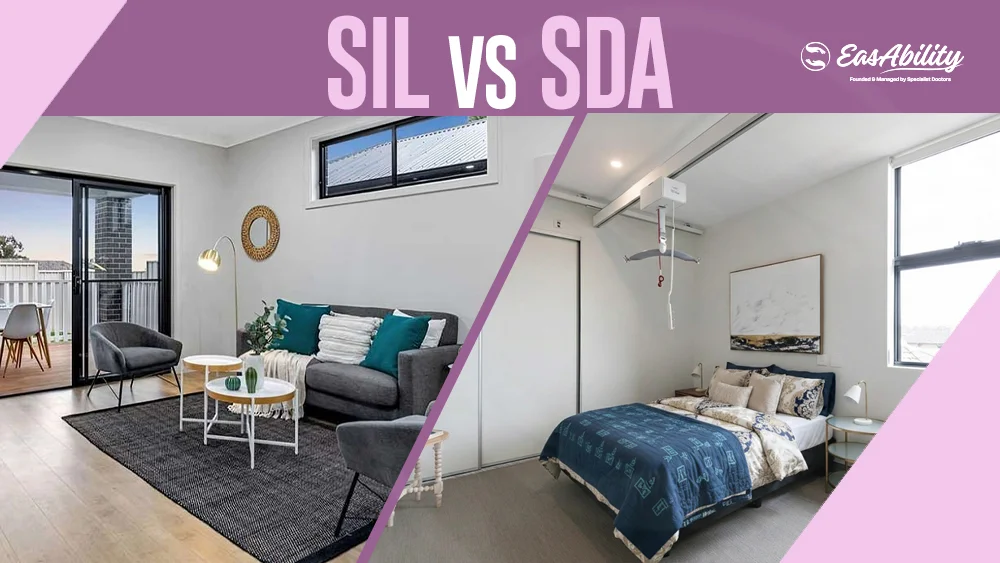
The SDA accommodations are not normal houses with minor modifications. They include buildings designed specifically to accommodate individuals with disabilities. Everything in the home is designed to remove barriers.
For example, wide hallways support wheelchair movement. Reinforced bathrooms support the use of hoists and mobility aids. Smart home systems allow residents to control lighting, doors, or temperature using assistive technology.
The main goal of SDA is simple but powerful:
- It provides people with a safe, stable home environment where they can live with dignity and independence, even with very high support needs.
- SDA does not include personal care or daily support services. Instead, it provides the physical environment in which those services can safely occur.
Under the NDIS, SDA funding is not automatically given. It is only approved when a person shows they have extreme functional impairment or very high support needs that cannot be met in standard housing.
Even with SDA funding, residents still contribute to living costs. Typically, payments include:
- Full SDA funding from NDIS for the housing component
- Commonwealth Rent Assistance (if eligible)
- Around 25% of Disability Support Pension (DSP)
This contribution system ensures fairness while maintaining sustainable housing.
SDA providers manage and maintain the property. Their responsibility is to ensure the home remains accessible, safe, and suitable for long-term independent living.
What is SDA NDIS and how it works?
When people ask what SDA is in NDIS, they are really asking how the funding system works in practice.
SDA comes under the NDIS housing support category. It does not replace other supports. Instead, it works as part of a bigger care plan.
Here’s how it works in real life:
The NDIS assesses the participant. If it is not possible for them to reside in mainstream accommodation due to severe disability, the NDIS approves access to SDA funding. With approval, they can select an SDA property of their choice and design criteria.
The NDIS then pays SDA providers directly to cover housing costs. The participant pays their portion of rent based on income support.
This system allows people to live in homes designed specifically for them, rather than trying to adapt to unsuitable housing.
SDA Funding Eligibility and Support Coverage
SDA funding is not general housing support. It is highly specific and only applies to those with substantial functional impairments.
A person needs to demonstrate:
- Profound physical, intellectual, or psychosocial impairment
- Major obstacles to living independently in regular housing
- The need for housing accommodation designs
The NDIS requires substantial evidence, which is usually provided by medical professionals, occupational therapists, or support coordinators.
SDA Funding Covers:
- Construction of specialist homes
- Ongoing maintenance
- Accessibility upgrades
- Property management services
- It does NOT cover:
- Daily personal care
- Food and groceries
- Transport
- Support workers
This distinction is crucial as it illustrates that SDA involves the provision of accommodation structure and not assistance with daily living.
What is SIL (Supported Independent Living)?
SIL is a scheme funded by the NDIS that provides support services to people who need help with day-to-day activities but want to maintain their independence.
It does not involve providing housing; instead, it helps fund the hiring of support workers who assist individuals with activities in their own homes.
Such assistance can include:
- Personal care (bathing, dressing, grooming)
- Preparing meals
- Housework
- Taking care of medications
- Financial planning
The degree of assistance required varies from person to person. Some people require only a few hours of assistance per day. Others may require 24-hour assistance.
SIL is not about replacing independence. It is about building it. Support workers help participants learn skills over time so they can become more confident in daily life.
What is SIL in NDIS Support Services?
When people search for what SIL is in NDIS, they are trying to understand where it fits in the system.
SIL comes under the Core Supports budget in NDIS plans. It is flexible and tailored to individual needs.
Unlike SDA, SIL is not tied to a specific type of house. You can receive SIL support in:
- Shared homes
- Private rentals
- SDA properties
- Group homes
This flexibility is one of its biggest strengths. It focuses on people, not buildings.
What is A SIL House and How it Functions
A SIL house is a shared living arrangement where multiple participants live together with on-site support workers.
These homes usually include private bedrooms for each resident and shared living spaces like kitchens and lounges.
Support staff are present to help with daily routines, safety, and skill development.
A SIL house creates a balance between independence and support. Residents still make their own choices, but help is always available when needed.
SIL vs SDA: Key Differences You Must Know
The difference between SIL and SDA becomes clearer when you separate their purpose.
Purpose
- SIL focuses on daily living support
- SDA focuses on physical housing design
Funding
- SIL funds support workers
- SDA funds housing infrastructure
Focus
- SIL builds independence skills
- SDA provides accessible housing
Flexibility
- One of the most important differences is control.
- If you are unhappy with your SIL provider, you can change them without moving house.
- If you want to move house, you can change SDA without losing SIL support.
SIL vs SDA Comparison Table
| Feature | SIL (Supported Independent Living) | SDA (Specialist Disability Accommodation) |
|---|---|---|
| Main Purpose | Daily living support | Specialist disability housing |
| Focus | Builds independence skills | Provides accessible housing |
| Support Type | Support workers for daily tasks | No daily support included |
| Housing Role | Uses existing homes | Purpose-built housing |
| Funding Covers | Support services | Housing costs & design |
| Eligibility | Needs support, can live in the community | High or extreme support needs |
| Tenancy | Participant manages tenancy | Provider may manage housing |
| Flexibility | High flexibility to move | Less flexible due to housing type |
| Goal | Independent living support | Safe, long-term housing |
| Best For | People needing daily help | People needing specialist housing |
Types of SIL and SDA Housing Options
SIL Housing Options
- Shared living with support workers
- Individual apartments with visiting support
- Group homes with structured routines
SDA Housing Options
- Cluster housing with shared support services
- Co-residential homes with live-in carers
- Farm-style communities
- Campus-style accommodation with multiple units
Each option supports different levels of independence and care needs.
SIL Eligibility and SDA Eligibility Criteria
SIL Eligibility
To access SIL funding, a participant must:
- Be an approved NDIS participant
- Need support with daily tasks
- Be able to maintain tenancy with assistance
- Does not require specialist housing
SIL suits people who can live in standard housing with the right support.
SDA Eligibility
To access SDA funding, a participant must:
- Be an NDIS participant with SDA approval
- Have extreme functional impairment or very high needs
- Be unable to live in standard housing safely
- Provide strong clinical evidence
SDA is reserved for the highest support needs.
SIL vs SDA: Choosing the Right Option
Choosing between SIL and SDA depends on your level of independence and safety needs.
Choose SIL if:
- You want to live independently with support
- You can manage a tenancy with help
- You prefer flexible living arrangements
Choose SDA if:
- You need a fully accessible home
- Safety is a major concern
- Standard housing is not suitable
Some people use both together. SDA provides the home, and SIL provides the support inside it.
The Role of EasAbility in SIL and SDA Services
Navigating NDIS housing options can feel overwhelming. The terms sound technical, and the funding system can feel confusing at first.
That’s where EasAbility plays an important role.
EasAbility helps people understand the difference between SIL and SDA in a practical way. Rather than simply defining each term, the emphasis is on addressing practical needs and objectives.
The team supports participants in:
- Understanding NDIS funding
- Choosing between SIL and SDA
- Finding suitable housing options
- Accessing the right level of support
The goal is not just to place someone in a house or service. The goal is to help them build a life where they feel safe, included, and independent.
At EasAbility, the focus stays on empowerment. Every person deserves a living arrangement that supports their goals, not limits them.
Conclusion
The difference between SIL and SDA comes down to one simple idea:
- SIL gives you support
- SDA gives you housing
They both work together under the NDIS to improve their quality of life. Knowing the differences between the two will enable participants to make informed choices and maintain stability in the long run.
If utilised properly, both SIL and SDA do more than provide funding. They become tools that open doors to independence, safety, and choice.
EasAbility Care – General Information Disclaimer
The information provided on this page is for general informational purposes only and does not constitute professional, legal, or NDIS advice. While reasonable efforts are made to ensure accuracy, EasAbility Care makes no representations or warranties regarding the completeness, reliability, or suitability of the information.
Please note:
- EasAbility Care supports NDIS participants by assisting them to explore suitable accommodation options and other disability supports.
- EasAbility Care provides SIL services, community participation, and other NDIS-related supports.
- EasAbility Care may not own, manage, or directly provide Specialist Disability Accommodation (SDA) housing and usually works with registered SDA providers to help identify appropriate options.
- Eligibility for SDA and related supports is determined solely by the National Disability Insurance Agency (NDIA).
- Users should seek independent advice from the NDIA, Support Coordinators, or other qualified professionals before making decisions based on this information.
To the maximum extent permitted by law, EasAbility Care accepts no liability for any loss or damage arising from reliance on the information contained on this website. This disclaimer may be updated at any time without notice.